
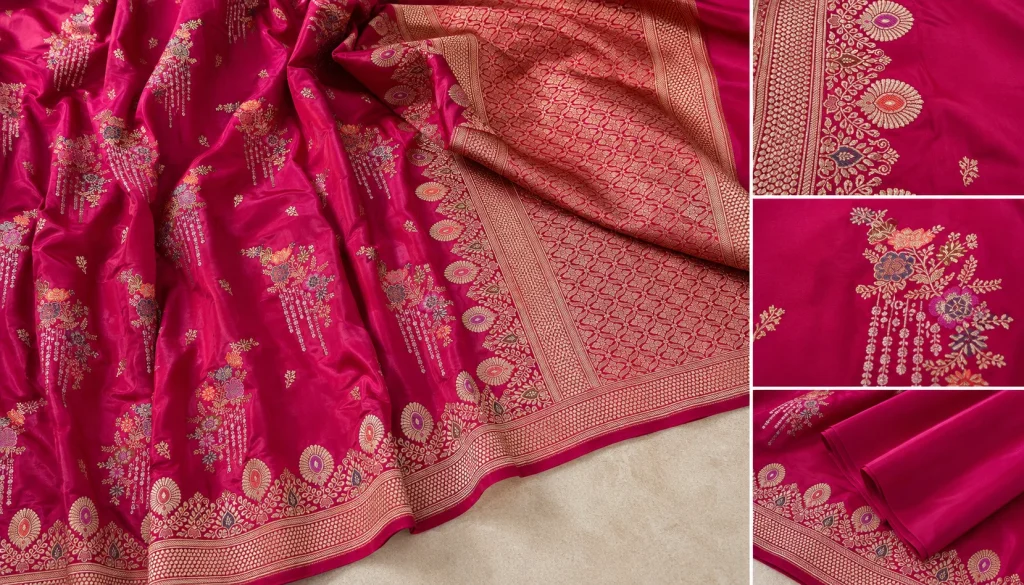
Have you ever loved the colour of a saree on your phone, only to wonder:
“But what if it looks completely different when it reaches me?”
If you are buying a Banarasi saree online for a wedding, celebration or important family occasion, this small doubt can become a big one.
Maybe the saree looks wine on one screen and maroon on another.
Maybe a soft onion pink looks brighter in a photograph.
Maybe what looks antique gold in one image appears more yellow in another.
And then there is zari.
Turn the saree one way and it may look warm gold.
Turn it another way and it may catch light differently.
This can make online saree shopping confusing.
But a colour difference does not always mean that the product photograph is wrong.
Sometimes the screen changes what you see.
Sometimes the lighting changes it.
Sometimes the fabric itself reacts to light.
And sometimes, yes, poor photography or too much editing can create a misleading picture.
The good news is that you can reduce much of this uncertainty before you buy.
This guide will show you how.
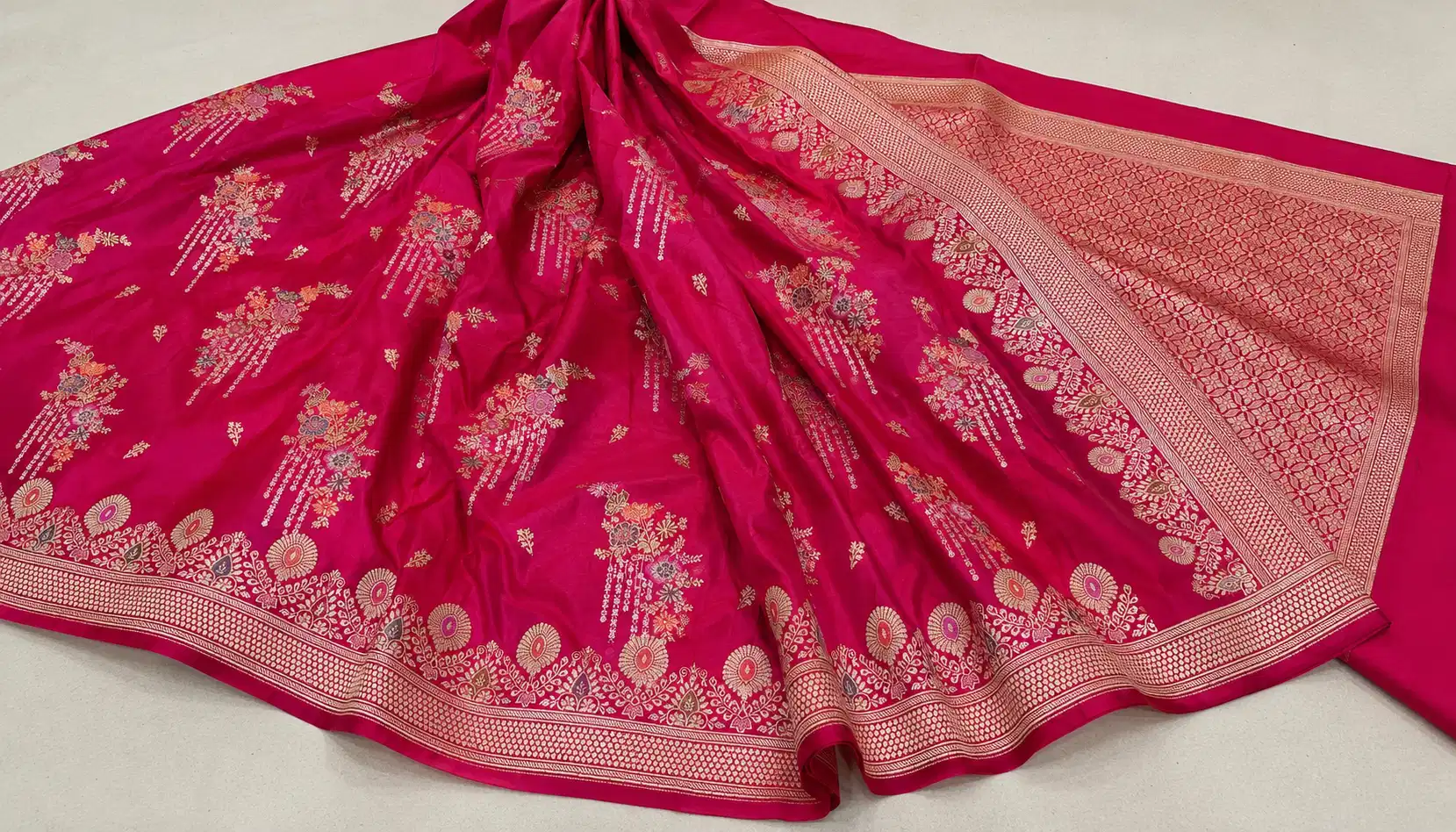
The goal is not to make an online photograph look identical on every screen. The goal is to understand the saree well enough that its real appearance does not surprise you.
Why Saree Colour Matters So Much
Colour is often the first thing that makes you fall in love with a saree.
Before you study the border, pallu, motifs or fabric, you may simply think:
“That shade is beautiful.”
And for an important saree, colour may connect with much more than taste.
You may be matching:
- wedding jewellery;
- a family dress code;
- your blouse;
- the groom’s outfit;
- a daughter’s bridal palette;
- an event theme;
- your skin tone;
- a particular piece of jewellery;
- or simply the colour you have imagined wearing for months.
This is why even a small difference can feel disappointing.
If you expected deep burgundy and received something that feels more plum, the saree may still be beautiful.
But it may not be what you had pictured.
For premium online saree shopping, the answer is not to pretend colour differences never happen.
The better answer is to understand why they happen and how to check before buying.
Why Does a Banarasi Saree Look Different on Your Phone?
There is rarely just one reason.
Usually several things work together.
Let’s understand them one by one.
1. Your Screen Changes Colour
A photograph does not travel directly from the saree to your eyes.
It goes through:
camera → editing → website → browser/app → your device → your display settings → your eyes
Every step can affect what you see.
Two phones can display the same photograph differently.
Even one phone can display the same image differently depending on its settings.
For example, Apple explains that True Tone can automatically change a display’s colour and intensity based on surrounding light. Night Shift intentionally moves display colours toward a warmer tone.
Android devices can also use different themes, display colour settings and accessibility colour adjustments.
So imagine this:
You are viewing a pink saree late at night with a warmer display setting.
Your sister opens the same product the next morning on a different phone.
You may both believe you are looking at a slightly different shade.
But the website image has not changed.
The screens have.
What should you do?
If colour is very important, look at the product on two devices.
For example:
- your phone;
- another family member’s phone;
- a tablet;
- or a laptop.
You do not need expensive equipment.
You simply want to see whether the colour appears reasonably consistent across more than one screen.
2. Screen Brightness Can Fool You
A screen set at very high brightness can make:
- pinks look brighter;
- reds appear more vivid;
- zari appear more luminous;
- pale shades appear lighter;
- and dark shades lose some depth.
A very dim screen can do the opposite.
Before making a colour-sensitive buying decision, keep your brightness at a comfortable middle level rather than judging the saree at maximum brightness.
This is especially useful for colours such as:
- wine;
- maroon;
- rani;
- onion pink;
- peach;
- rust;
- purple;
- deep green;
- navy;
- and muted pastels.
These shades can sometimes look quite different depending on the display.
3. Lighting Changes the Saree
Now we move from the screen to the saree itself.
Imagine the same saree photographed:
- beside a window;
- under a warm yellow bulb;
- under cool white LED light;
- outdoors;
- inside a photography studio.
It will not necessarily look exactly the same.
Light can change how your eye reads a colour.
That is why natural-light or daylight-reference photographs can be very useful when shopping online.
Some current online Banarasi buying guides also encourage shoppers to ask for natural-light photographs or videos when colour is important.
But remember:
natural light is a reference, not magic.
Morning daylight can look different from late-evening daylight.
Shade can look different from direct sunlight.
The saree itself may reflect light differently depending on its surface.
So do not depend on one photograph alone.
4. Silk and Shiny Fabrics React to Light
A matte cotton and a lustrous saree do not behave the same way in photographs.
A saree with sheen can catch light.
That means one fold may look brighter than another even though both are the same fabric colour.
This is especially important when viewing:
- Katan-style silk surfaces;
- Tissue;
- Kora/Organza;
- lustrous silk blends;
- metallic-looking borders;
- and zari-rich pallus.
A flat photograph freezes only one moment and one angle.
But when you actually wear the saree, it moves.
The light moves across it.
That is one reason video can be so useful.
5. Zari Can Change the Colour You Think You Are Seeing
Zari creates another challenge.
A metallic-looking border can reflect nearby light.
Under one condition it may appear:
- warm gold;
while under another it may appear:
- pale gold;
- antique gold;
- champagne;
- silver-gold;
- or brighter yellow-gold.
That change can also affect how you perceive the saree body.
Imagine a burgundy saree next to a bright gold border.
Now imagine the same burgundy next to a softer antique-gold-looking border.
The body colour may seem different simply because the surrounding metallic colour changes your visual impression.
So when evaluating a Banarasi saree online, do not judge colour from the body alone.
Look at the:
body + motifs + border + pallu together.
6. Photography Can Change Colour
A camera also makes decisions.
It decides how bright the image should be.
It decides white balance.
It records colour through its own sensor.
Then the photograph may be edited before it reaches the website.
Good editing can make a photograph more accurate and easier to view.
For example:
- correcting exposure;
- removing an unwanted colour cast;
- improving clarity;
- cropping;
- straightening;
- cleaning the background.
But aggressive editing can create a problem.
Too much:
- saturation;
- contrast;
- warmth;
- brightness;
- colour replacement;
- or filter use
can make a saree look more dramatic than it really is.
This is why, for a premium saree, you should ideally see several photographs rather than one highly polished hero image.
7. Different Devices Reproduce Colour Differently
This is not only about brightness.
Devices use different screens and colour profiles.
Adobe’s colour-management documentation explains that devices reproduce colour differently and that colour profiles exist partly to manage those differences across displays and other devices.
For the average saree buyer, you do not need to understand ICC profiles or professional colour science.
You only need to remember:
The colour on your screen is a representation of the saree, not the saree itself.
That single idea can prevent many unrealistic expectations.
What Is a Normal Colour Difference—and What Is Not?
This is where buyers often need more clarity.
A small visual variation is different from a material mismatch.
Consider these examples.
| Situation | Usually Reasonable? |
|---|---|
| Burgundy looks slightly warmer in daylight | Yes |
| Gold zari looks brighter under strong light | Yes |
| Pale pink appears slightly cooler on another phone | Yes |
| Saree looks a little darker indoors | Yes |
| Product shown as wine arrives clearly bright orange | No |
| Website shows blue but delivered product is clearly green | No |
| Product colour materially differs from all supplied references | A genuine concern |
| Tiny variation caused by screen/lighting | Usually not the same as receiving the wrong colour |
The key word is:
Materially
If the basic colour family and overall appearance are consistent, small differences can happen.
If the received saree is fundamentally different from what was represented, that is another matter.
The Best Way to Check a Banarasi Saree Colour Before Buying
This is the most important part of the guide.
For a premium purchase, try not to depend on one photograph.
Use a colour-verification routine.
Step 1: Look at the Full Saree
Start with the complete view.
Do not zoom immediately.
Ask:
- What is the dominant colour?
- Is there one colour or several?
- Does the border contrast strongly?
- Does the pallu use another colour?
- Are the motifs multi-coloured?
The full image gives you context.
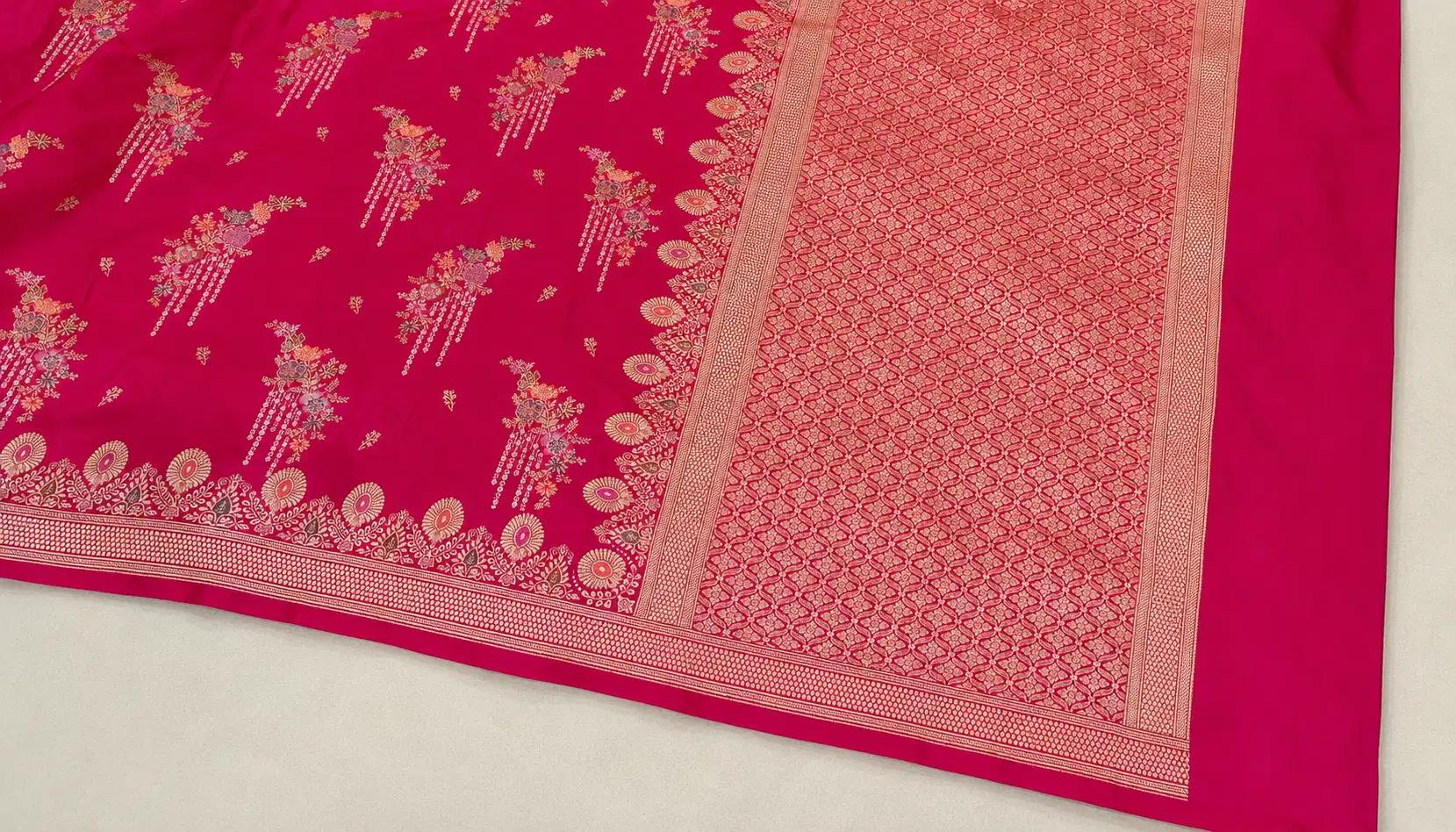
Step 2: Look at the Body Close-Up
Now inspect the saree body.
Look for a photo where:
- a reasonable amount of fabric is visible;
- there are no heavy shadows;
- the colour is not being overwhelmed by zari;
- and you can see the base fabric clearly.
Do not judge colour from a tiny motif macro alone.
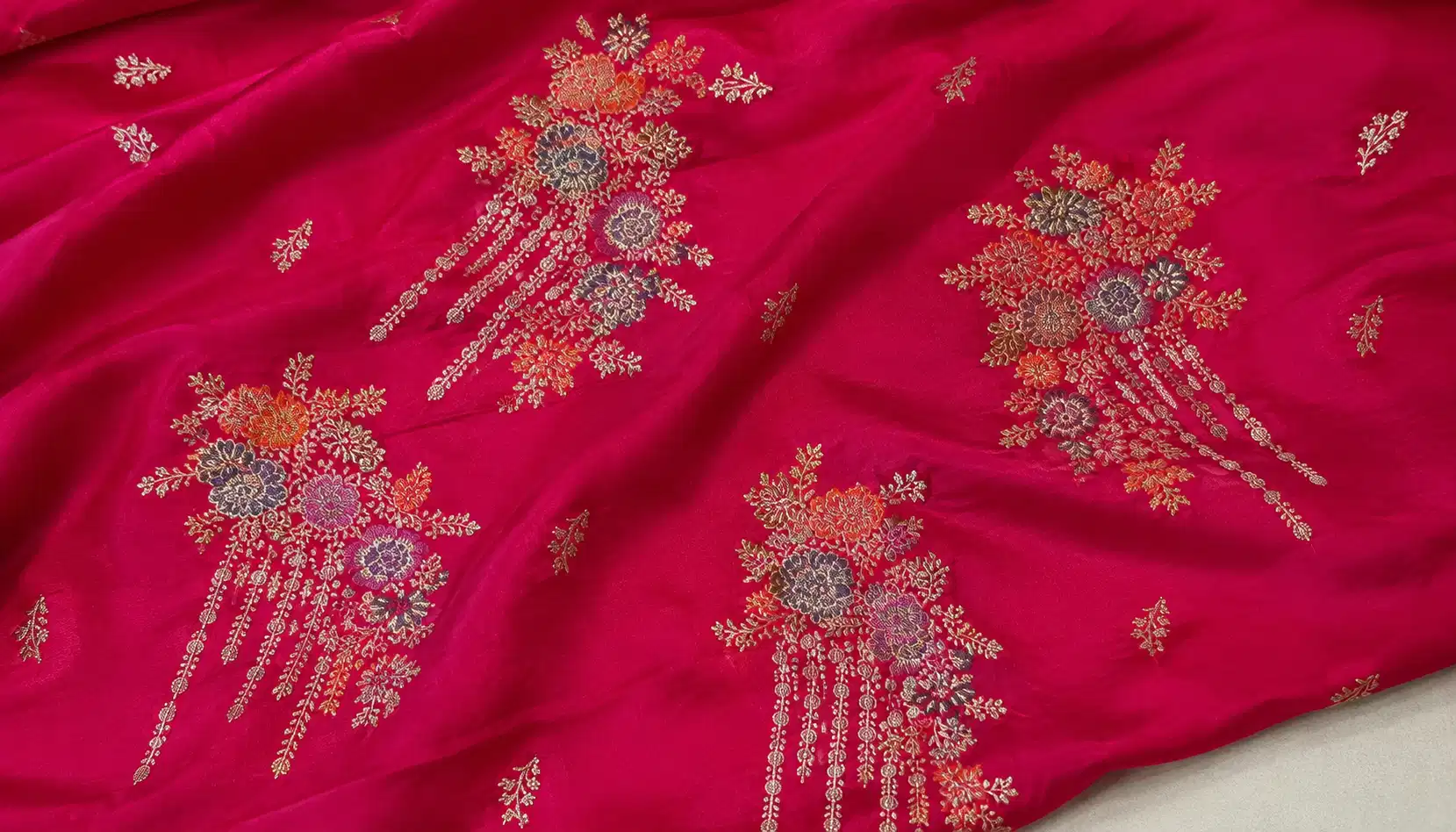
Step 3: Look at the Border Separately
The border may change your perception of the body colour.
A broad gold-looking border can make a muted saree seem richer.
A silver-toned border can make the same colour feel cooler.
So study the border separately.
Ask:
Do I like this border with this body colour?
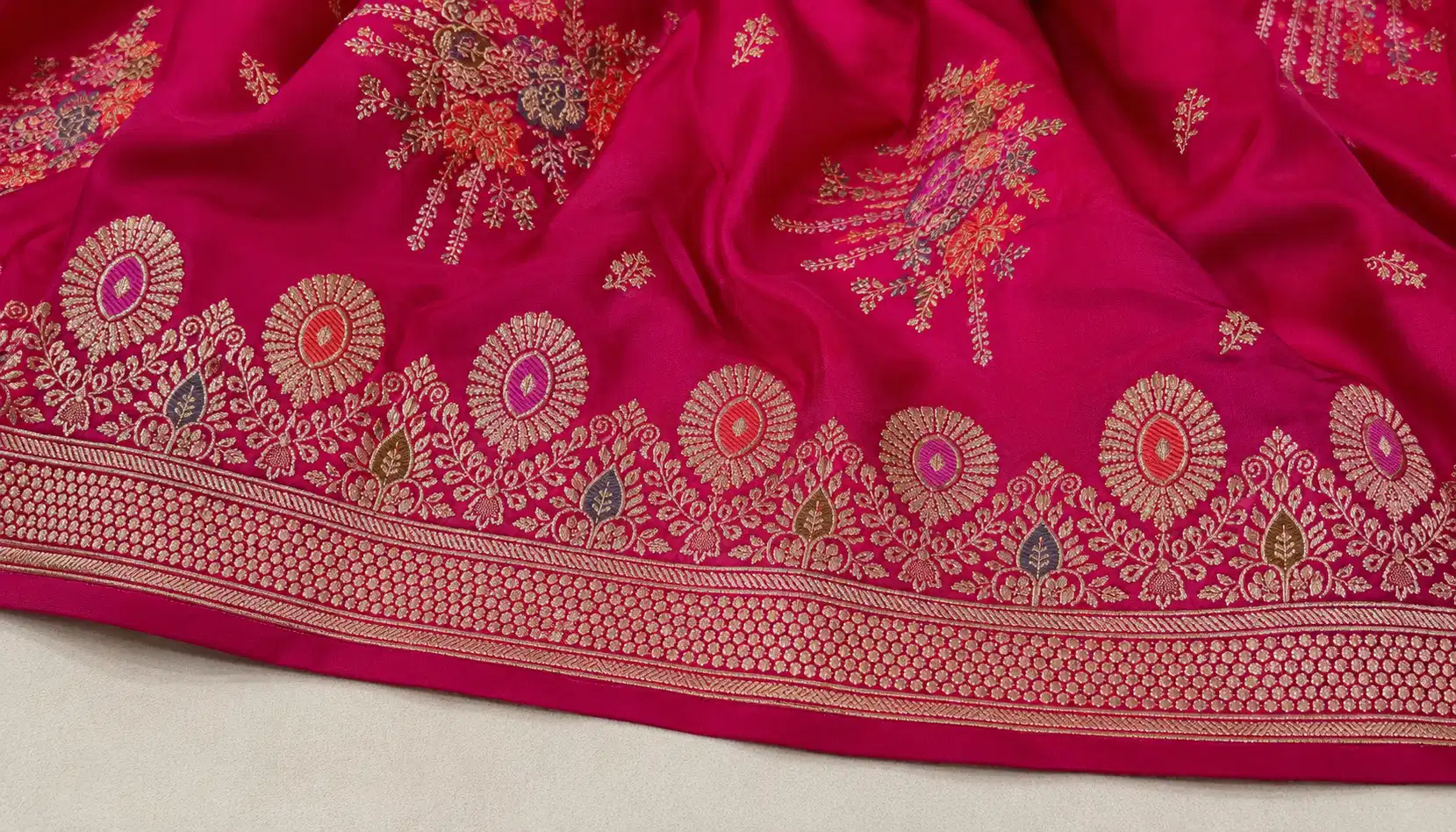
That is just as important as asking whether you like the colour itself.
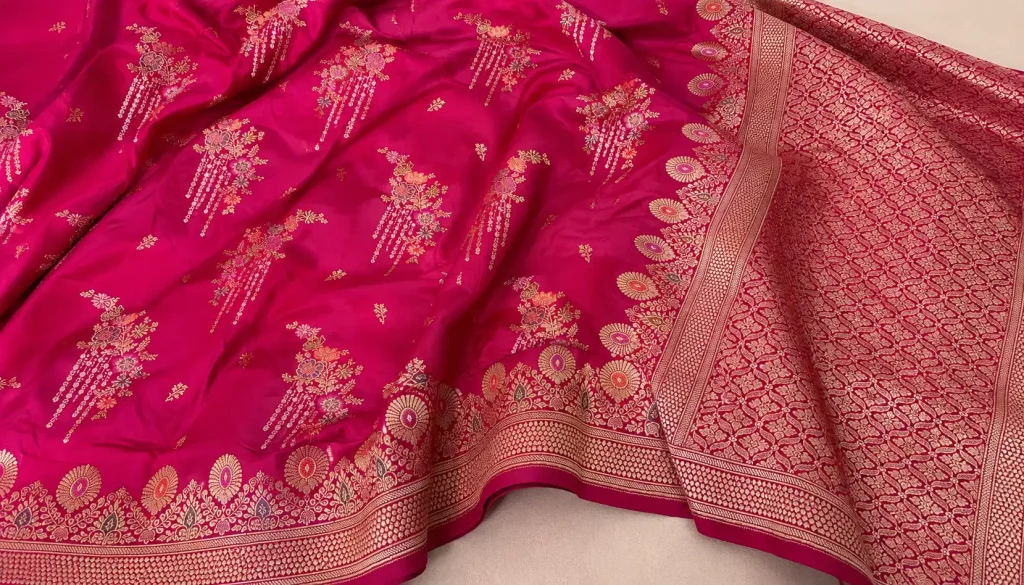
Step 4: Always See the Pallu
The pallu can be much richer or more detailed than the body.
Sometimes it can also introduce another colour.
This matters when you drape it over your shoulder.
If the body is soft pink but the pallu carries strong metallic or coloured work, the finished look may be much more dramatic than the body photograph suggests.
Never buy a premium saree without understanding the pallu.
Step 5: Ask for a Natural-Light Reference
If exact colour matters to you, ask the seller:
“Can you please show this saree in natural daylight?”
You do not need a professionally edited photograph.
In fact, a simple phone photo taken near natural light can sometimes be useful as an additional reference.
Notice the word additional.
Do not replace all other product photographs with one daylight image.
Compare them.
Step 6: Ask for a Video
A video does something a photograph cannot.
It shows movement.
You can see:
- the fabric changing angle;
- light moving over the surface;
- zari becoming brighter and softer;
- folds forming;
- pallu movement;
- transparency;
- and colour under changing reflection.
For lustrous or zari-rich sarees, this can be especially helpful.
A current online bridal-saree shopping guide also specifically recommends asking sellers for video to better understand drape, fall and shimmer.
Step 7: Ask the Seller to Describe the Colour in Words
This is surprisingly useful.
Ask:
“How would you describe this colour in person?”
The answer might be:
- deep wine;
- burgundy with a purple undertone;
- warm maroon;
- cool rani pink;
- dusty rose;
- peach-pink;
- bottle green;
- emerald green;
- muted mustard;
- champagne gold.
Photographs show.
Words clarify.
When both tell the same story, you can buy with more confidence.
Step 8: Tell the Seller What You Are Trying to Match
If you are matching jewellery, blouse fabric or another outfit, say so.
For example:
“I need a wine shade, but I do not want it to look purple.”
That sentence is much more useful than:
“Is this wine?”
Or:
“I need a soft pink for a morning wedding, not bright candy pink.”
A good consultation becomes better when your requirement is specific.
Step 9: Check the Saree on Another Screen
Before paying for a high-value colour-sensitive purchase:
Open the same product on another device.
Do not compare tiny differences.
Instead ask:
Does the general colour story remain the same?
If yes, that is reassuring.
If one screen says “purple” and another says “red,” ask for more clarification.
Step 10: Do Not Judge from Instagram Alone
Social-media images can be:
- compressed;
- filtered;
- cropped;
- edited;
- viewed inside different app settings.
If you discovered the saree on Instagram, go to the actual product listing.
Then ask for actual product references if required.
Instagram should help you discover the saree.
It should not always be your only source for evaluating it.
A 60-Second Colour Checklist Before You Pay
Before completing your Banarasi saree online shopping order, ask yourself:
Have I seen…
- the full saree?
- the body clearly?
- the border?
- the complete pallu?
- the blouse piece?
- a fabric close-up?
- at least one neutral or natural-light reference?
- the saree in movement/video, if colour is important?
- the written colour name?
- the product on more than one screen if necessary?
If you can answer yes to most of these, your risk of an unpleasant surprise becomes much lower.
Be Extra Careful With These Colour Families
Some colours are harder to describe than simple black or white.
Wine, Burgundy and Maroon
These shades can move between:
- red;
- brown;
- purple;
- and deep berry tones.
If you specifically dislike purple undertones, ask.
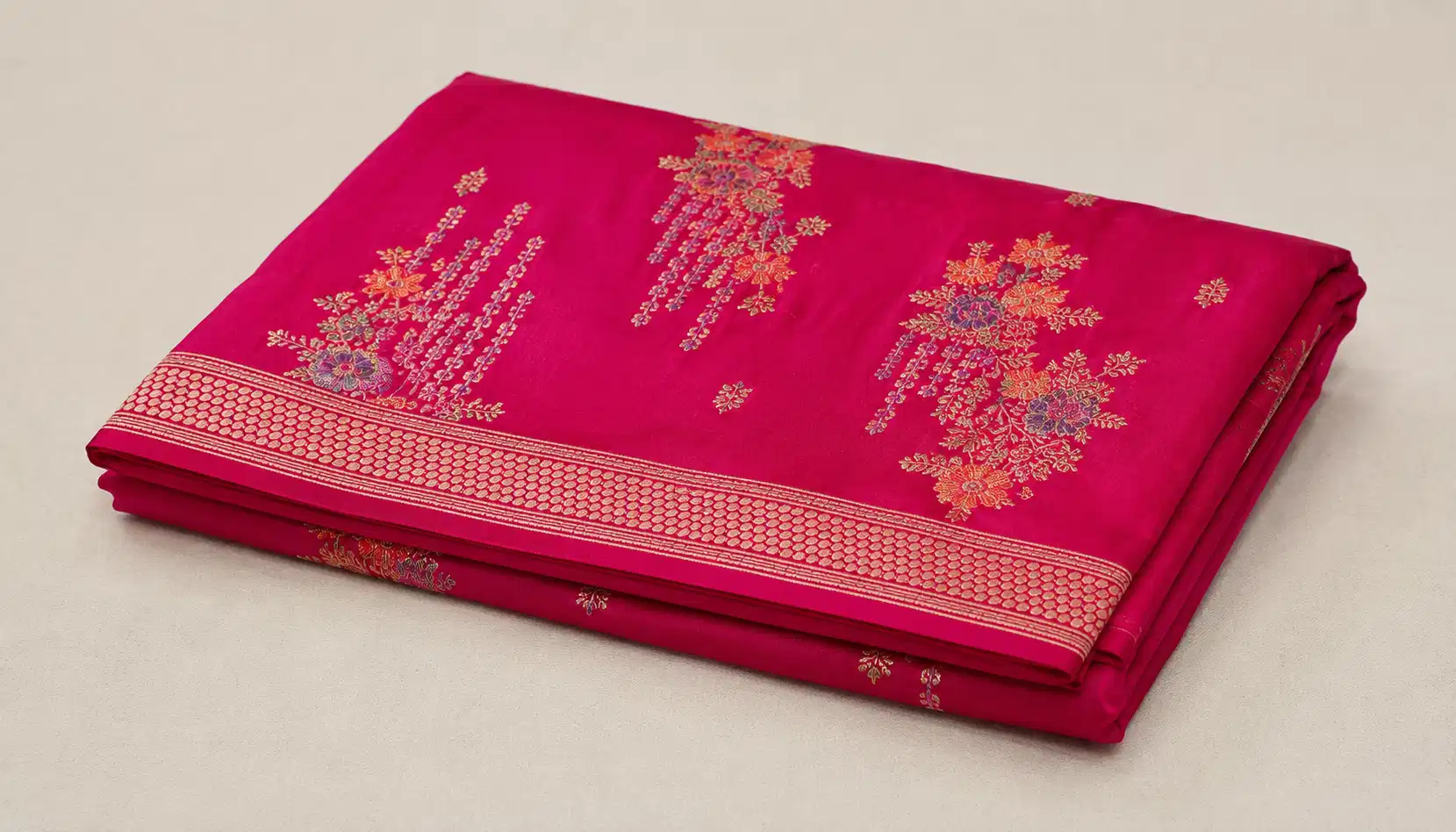
Rani, Magenta and Fuchsia
These words are often used differently by different sellers.
One person’s rani pink may be another person’s magenta.
Ask for natural-light reference.
Peach, Blush and Onion Pink
These delicate colours can be strongly affected by:
- warm light;
- cool light;
- screen brightness.
Ask whether the shade feels:
warm, cool, peachy, dusty or rosy.
Green
Bottle green, emerald, mehendi, olive and teal-green are very different.
A photograph alone may not tell you enough if you are trying to match jewellery or another outfit.
Beige, Gold, Champagne and Tissue Tones
These become even more complex because metallic reflection may be involved.
A saree can appear golden in one frame and beige in another.
This may be normal behaviour of the material rather than an incorrect photograph.
Why Wedding Saree Buyers Should Be Even More Careful
A casual purchase gives you flexibility.
A wedding saree may not.
You may already have:
- jewellery;
- blouse plans;
- footwear;
- a makeup palette;
- family coordination;
- photographs planned;
- or a fixed event date.
That means colour becomes part of a larger look.
If your wedding or celebration saree must match something specific, do not wait until after delivery to solve questions you could have asked before ordering.
Send the seller a clear message.
For example:
“I am considering this saree for a daytime wedding. I need the colour to remain soft in natural light. Could you please show me an unfiltered daylight view and a short video?”
That is a very reasonable request for an important online purchase.
What Sellers Should Do Better
Colour accuracy is not only the buyer’s responsibility.
A serious online saree seller should also reduce uncertainty.
Ideally, a strong saree product listing should provide more than one kind of image.
For example:
1. Full saree view
Shows overall colour balance.
2. Body view
Shows the base fabric clearly.
3. Motif close-up
Shows detail.
4. Border close-up
Shows border colour and zari appearance.
5. Complete pallu
Shows the most decorative area.
6. Fabric close-up
Shows surface and sheen.
7. Natural-light reference
Helps buyers compare the studio representation with another lighting condition.
8. Blouse piece
Prevents another common surprise.
9. Movement/video
Shows how the colour and zari behave as the saree moves.
This is not about making a website look more luxurious.
It is about giving the buyer enough information to make a confident decision.
Beautiful photography earns attention. Clear product evidence earns confidence.
Why Trishtara Kashi Takes Colour Questions Seriously
When you are buying a saree for an important occasion, “almost the same” may still matter to you.
That is why the better approach is not to promise that a colour will look identical on every phone, laptop and lighting condition.
No responsible online seller can control every customer’s screen.
Instead, the aim should be to help you understand the saree from more than one reference.
At Trishtara Kashi, customers can ask for additional product clarification, photographs or video assistance when colour, drape, border, pallu or another detail is important to the purchase decision.
The purpose is simple:
reduce uncertainty before payment rather than deal with avoidable disappointment afterwards.
What If the Saree Arrives and Looks Slightly Different?
First, do not judge it immediately under poor artificial light.
Try this:
- Open the saree carefully.
- Look at it in neutral daylight.
- Turn off unusually warm or coloured lighting.
- Compare it with the actual product references you used before purchase.
- Look at both the body and pallu.
- Allow for normal changes caused by reflection and viewing angle.
Then ask:
Is this simply a small visual difference—or is the product materially different?
That distinction matters.
A silk or zari-rich saree appearing a little warmer or cooler in another light is not the same as receiving a completely different colour.
What If the Difference Is Major?
If you believe the received product is materially different from what was represented, contact the seller promptly.
Keep:
- the packaging;
- order details;
- photographs;
- videos;
- and, where possible, your unboxing video.
For Trishtara Kashi orders, visible product concerns should ordinarily be reported within 48 hours of delivery, in line with the applicable Return, Exchange & Refund Policy.
Do not alter, wash, dry-clean, cut or stitch the saree while a genuine product claim is being reviewed.
Colour Mismatch vs Change of Mind: They Are Not the Same
This is an important difference.
Suppose you order a burgundy saree.
It arrives as burgundy.
But after seeing it on yourself, you decide:
“Actually, I think green would suit me better.”
That is a change of preference.
Now suppose the product represented as burgundy arrives clearly bright orange.
That may be a product-description or fulfilment issue.
These two situations are not the same.
This is why clear photographs, written colour descriptions and pre-purchase questions protect both buyer and seller.
Common Mistakes Buyers Make
Mistake 1: Buying from One Hero Photograph
A beautiful campaign image can attract you.
It should not be your entire buying decision.
Mistake 2: Keeping Your Phone at Maximum Brightness
Very bright screens can make photographs look more vivid than expected.
Mistake 3: Buying at Night Without Checking Again
Warm display settings and room lighting can influence your colour impression.
If the purchase is expensive, look again the next day.
Mistake 4: Looking Only at the Saree Body
Border and pallu can change the complete colour experience.
Mistake 5: Assuming “Gold” Is One Colour
Gold-looking zari can appear warmer, cooler, brighter or more muted depending on material and light.
Mistake 6: Not Telling the Seller What You Need
If you specifically need:
“deep red, not purple-red”
say that.
Do not assume the seller knows what shade you have imagined.
Mistake 7: Believing a Colour Name Is Exact
Terms like:
- wine;
- maroon;
- mauve;
- onion pink;
- rani;
- antique gold
are descriptions.
They are not universal colour codes.
Use the name together with images and video.
What About AI-Generated or Editorial Saree Images?
This is becoming increasingly important.
AI-generated, model-composed or editorial visuals can be beautiful for showing:
- styling;
- draping;
- blouse ideas;
- occasion mood;
- jewellery pairing.
But they should not become your main reference for exact product colour.
When an actual product and an editorial representation are both available, use the:
actual product photographs + actual product video + written product description
as your primary buying references.
The model image should help you imagine the look.
The product images should help you understand what you are buying.
A Better Way to Think About Online Saree Colour
Do not ask:
“Can an online photo show me the colour with 100% perfection?”
A better question is:
“Has the seller given me enough different references to understand the colour confidently?”
This changes everything.
You stop expecting one photograph to do an impossible job.
Instead, you evaluate the complete information.
Your Banarasi Saree Online Shopping Colour Checklist
Save this before your next purchase.
| Check | Done? |
|---|---|
| Full saree viewed | ☐ |
| Body viewed clearly | ☐ |
| Motif close-up checked | ☐ |
| Border checked | ☐ |
| Complete pallu checked | ☐ |
| Blouse piece checked | ☐ |
| Written colour name read | ☐ |
| Natural-light reference checked | ☐ |
| Video requested if needed | ☐ |
| Second screen checked for important colour | ☐ |
| Seller asked about undertone | ☐ |
| Event/jewellery matching needs explained | ☐ |
| Return/refund conditions read | ☐ |
You do not need to perform every step for every inexpensive purchase.
But the higher the price and the more important the occasion, the more useful this checklist becomes.
Key Takeaways
- A Banarasi saree may look slightly different online because screens, brightness, lighting, camera processing, fabric sheen and zari reflection all influence colour.
- Apple and Android devices themselves can use settings that alter how colours appear on screen.
- Small colour differences are not the same as receiving a materially different colour.
- Never depend on one heavily styled photograph for an important purchase.
- Check the full saree, body, border, pallu and blouse piece.
- Ask for a natural-light photograph when colour matters.
- Ask for a video when you need to understand movement, lustre and zari.
- Ask the seller to describe the colour in words.
- Check important colours on another device.
- Use actual product photographs as the main reference rather than only styled or AI-assisted visuals.
- Read the seller’s product, shipping and return policies before buying.
- For an expensive wedding or celebration saree, asking questions before payment is better than making assumptions.
Frequently Asked Questions
Why does my saree look different from the website photograph?
Screen settings, device colour reproduction, brightness, surrounding light, camera settings, fabric lustre and zari reflection can all make a saree appear somewhat different from one viewing condition to another.
How can I check the real colour of a saree before buying online?
Ask for multiple product images, a natural-light reference and, if necessary, a short video. Also ask the seller to describe the colour and undertone in words.
Are natural-light photos always 100% accurate?
No. They are useful additional references, but daylight itself changes with time, location, weather and surrounding surfaces. Your screen can still affect what you see.
Why does zari look more yellow in some photographs?
Metallic-looking threads reflect surrounding light. The viewing angle, camera exposure, screen brightness and lighting can change how the zari appears.
Should I ask for a video before buying an expensive Banarasi saree?
If colour, movement, sheen, border or pallu are important to your decision, a video can be very useful because it shows the saree under changing angles instead of freezing one moment.
Why does the same saree look different on two phones?
Different displays and device settings can reproduce colour differently. Some phones also use settings that automatically change colour temperature according to surrounding light.
What colours are hardest to judge online?
Subtle or mixed shades such as wine, burgundy, maroon, mauve, onion pink, peach, teal, olive, champagne and certain metallic-looking tones may need more clarification than simple colour families.
Can I trust the colour name written on a website?
Use it as one reference, not the only reference. Words such as wine, rani, maroon and antique gold may be interpreted differently. Compare the written name with actual product photographs and video.
Should I use AI model images to judge exact saree colour?
No. Styled or AI-assisted images are better used for drape and styling inspiration. Actual product-detail photographs, videos and written specifications should be your main reference.
What should I do if the received saree is clearly a different colour?
Photograph the product, preserve the packaging and contact the seller promptly according to the seller’s return or grievance process. Avoid washing, cutting or altering the saree while the issue is being reviewed.
Is a small colour difference considered a defect?
Not automatically. Small differences caused by screen settings, light, photography, fabric sheen or reflection may occur. A product that is materially different from what was represented is a different issue.
Conclusion: You Should Not Have to Guess
Online saree shopping will never be exactly the same as standing inside a store.
You cannot touch the fabric through a screen.
You cannot make every phone show exactly the same shade.
And you cannot stop silk and zari from reacting to light.
But that does not mean buying a premium Banarasi saree online should feel like a gamble.
A good buying decision comes from better information.
See the whole saree.
Study the body.
Look at the border.
Open the pallu.
Check the blouse piece.
Ask for natural light.
Watch the saree move.
Ask what the seller calls the colour in person.
And if something really matters to you, say it before you pay.
Confidence in online saree shopping does not come from pretending uncertainty does not exist. It comes from reducing that uncertainty before you buy.
The saree you finally choose should not only look beautiful on a screen.
It should make sense for the occasion, the colour you wanted and the way you imagined wearing it.
That is the difference between simply shopping online and buying thoughtfully.